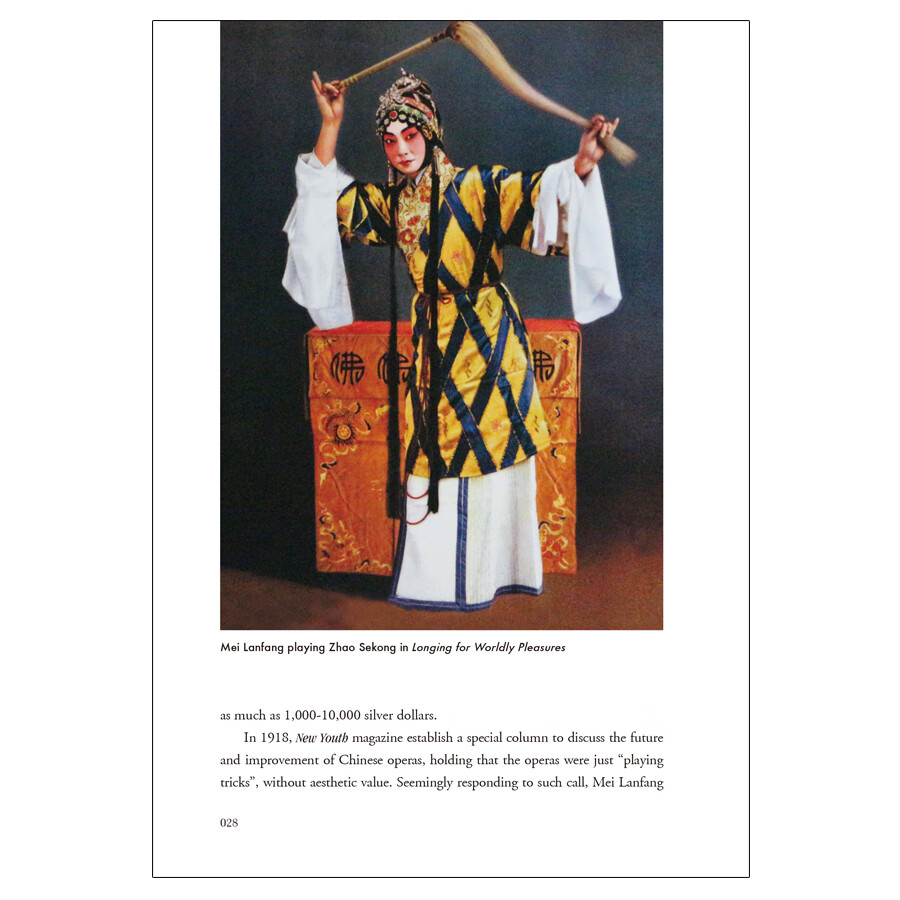
There are many ways through which the West gets to know about China, including Peking Opera, the only Chinese opera genre named after a city. In the 1930s, Chinese great artist Mei Lanfang led a Peking Opera troupe to make its debut in the Broadway Theatre in New York. The performance was so loved by the American audiences that it was suggested Peking Opera actually broke down all the cultural barriers between the East and the West.
As a matter of fact, Peking Opera is only one of hundreds of traditional Chinese opera modes. Chinese opera came into being in the 12th century. Compared with ancient Greek drama and ancient Indian Sanskrit drama, it was of relatively late birth, but its vitality has surpassed all others. For more than 800 years, Chinese opera has always maintained its basic form and artistic characteristics, retaining its great popularity.
Among many Chinese opera genre, the history of Peking Opera is less than 200 years; however, it has become the most widespread and influential type of opera in China. During the reign of Qianlong emperor (1736- 1796), since four Anhui troupes performed in Beijing, Peking Opera began to occupy the central position of the performing stage with its unique charm and art form. The Qing court adored it, enabling it to finally evolve into a “National Opera”. The popularity of Peking Opera in China is unprecedented. People all over the country love and chase after Peking Opera, which leads to the upsurge of listening to and singing opera.
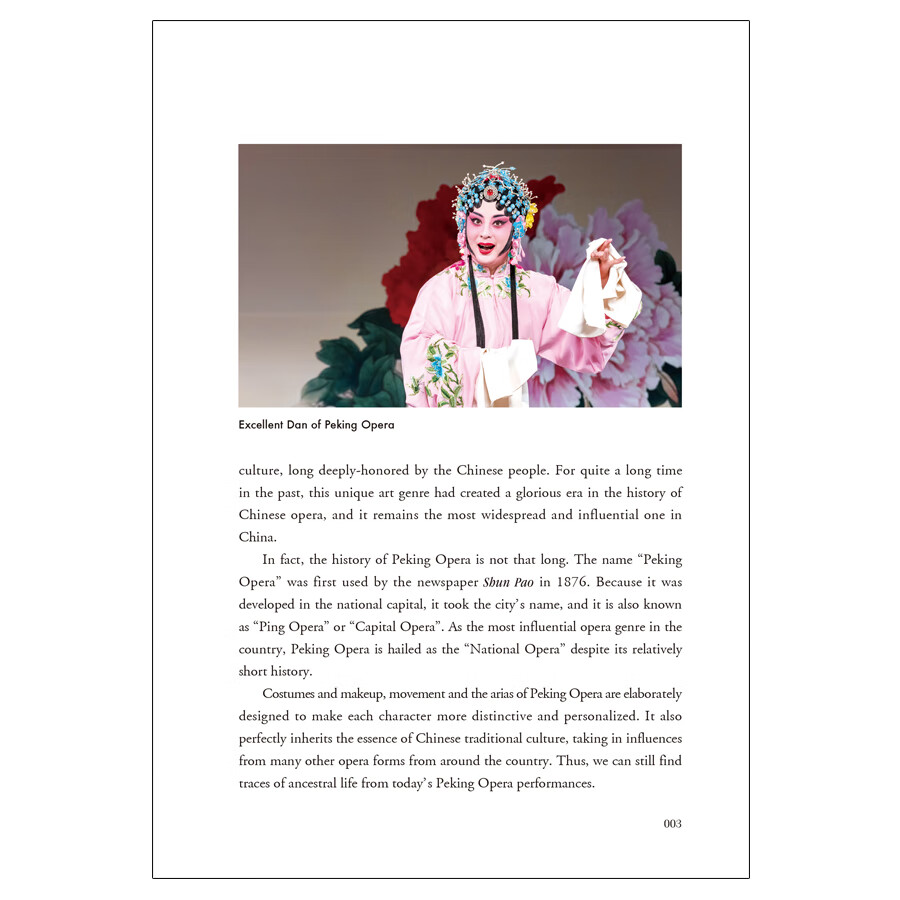
Peking Opera boasted a large number of artists with profound attainments, including Cheng Changgeng, Tan Xinpei, Yang Xiaolou and Mei Lanfang, who promote the continuous development of Peking Opera art. “Tiaoban” is a system in which a troupe was placed in the charge of a Peking Opera master to draw a large audience. Famous Peking Opera actors presented the audiences with distinctive roles, facial makeup, costumes, aria, music accompaniment and props.
The roles of Peking Opera can be divided into five categories, namely Sheng, Dan, Jing, Mo and Chou. In fact, these roles are not exclusive to Peking Opera, but derived from the development of various opera genres long ago. Along with improvement in performing arts, some roles are normalized. In particular, as Mo roles are merged into Sheng roles, Peking Opera were gradually standardized as “Sheng, Dan, Jing, Chou”.
Since ancient times, Chinese opera has taken on a moralistic role. Audiences were under instruction from the drama and evaluate history with traditional rites. Peking Opera is no exception. Most of the Peking Opera repertoire has been drawn from ancient novels, legends and storytelling, although some have come from other plays, reflecting that Peking Opera has a close relationship with history not only in art, but also in repertoire. Although the repertoire performed on the Peking Opera stage is not necessarily related to actual historical events, it is inextricably linked with the nation’s long history. If all the plays in the repertoire were to be linked up that would form a vivid history of the Chinese nation.
The achievements of Peking Opera undoubtedly benefit from the abundant nutrition of Chinese traditional culture and other forms of vocal music. Since the early Qing Dynasty (about 17th-18th centuries), dramatic changes have taken place on the opera stage, mainly manifested in the presentation of folk and popular operas. The first is the prevalence of Yiyang Tune and Shaanxi Opera, amid the rise of local opera. Since then, it was no longer the world of Kun Opera legends, Kun Opera and Gaoqiang have their competitors from among the creativity of local people, and the opera stage presents a colorful scene.
From the middle of the Qing Dynasty to the beginning of the 20th century, a large number of new local operas began to appear across the country, including Yue opera, Ping opera, Huangmei Opera, etc. They all developed from folk operas, with strong local feel. After being brought into urban, they absorbed the artistic essence of Peking Opera, Bangzi and other operas, and became mature in performance, gradually forming a Chinese opera garden with the five major genre of “Peking Opera, Yue Opera, Huangmei Opera, Pingju and Yu Opera” as the core, which brought spiritual satisfaction and entertainment to people in the age of material scarcity.
Since the end of the 19th century, Peking Opera has gone abroad, constantly spreading its influence to the world. Other Chinese operas, such as Yue Opera, Cantonese Opera, Yu Opera, Tibetan Opera and Kun Opera, have also been performed abroad, so that dramatic art has made its mark on many stages and become an important part of world drama. The collection of these Chinese operas tell Chinese stories to the world. Chinese opera revive and step into future in the process of inheritance.
Wang Peiyu, a well-known veteran of Peking Opera, once said that there were two kinds of people in the world: those who like Peking Opera and those who don’t know they like it.
Peking Opera has become a symbol of China. At the same time, it has opened a window for the world to know more of China. Peking Opera is not only for Chinese, but also a global phenomenon.
Copyright © Purple Culture Co., Ltd. 2001 - 2026. All right reserved.