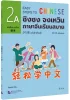
Easy Steps to Chinese for Kids (2nd Edition) is especially designed for non-Chinese background students, who are learning Chinese as a second/foreign language. The series is suitable for preschool children and first to fourth graders in primary school.
This series aims to help students lay a solid foundation in Chinese in terms of characters, especially simple characters, words, and short sentences through natural and gradual integration of language, themes and culture. The simultaneous development of listening, speaking and reading skills, and character writing as well as the ability to write short sentences in Chinese, is emphasized. The ultimate aim is to help students develop communication skills in a hope that they can use simple Chinese to communicate smoothly and effectively in real-life situations.
The Textbook plays an important role in helping students gain knowledge of the Chinese language needed to develop their communicative competence. The Workbook takes a supporting role, providing various age-appropriate and interesting exercises and activities that serve as meaningful practice and reinforcement.
Besides Textbook and Workbook, the series also includes Exercise book for writing, PowerPoint slides, word cards, picture flashcards, as well as digital resources, etc.
Features of Easy Steps to Chinese for Kids (2nd Edition):
·Pinyin is not specifically taught at this stage, but it always appears on top of the characters.
·Each simple character appears in the form of “shape, sound and meaning” and is accompanied with a vivid illustration, in a hope that students have a full understanding of the character learned.
·Strokes, stroke order and the structures of characters are not formally taught, but specially designed exercises are provided in both the Textbook and the Workbook. Each simple character is marked with a stroke order, and students can learn about the structure of a compound character through specifically designed exercises.
·The radical is an important component of most compound characters, and mastering radicals is very helpful for learning Chinese characters. Teaching experiments indicate that it is difficult to teach radicals in lower grades, therefore radicals are introduced starting Book 3. In this way, students can learn new compound characters more easily while reviewing the ones learned in Books 1 and 2.
·New words in each lesson do not appear in the form of a “new word list”. Each new word is introduced with Pinyin and English explanations, while some are accompanied with illustrations.
·Literacy is one of the focuses of this series. When learning the written form of a language, children learn to read first and then write words from memory later. This is how children learn written language. In this series, the learning of new characters, the recurrence of new words and the repetitive exercises are thus designed accordingly.
·Developing children’s listening and speaking skills is of paramount importance when teaching Chinese to children. Although children can acquire pronunciation naturally, teachers should ensure students speak with accurate pronunciation.
·Developing students’ reading skills is an important feature of the second edition. Carefully designed conversations, rhymes, different forms of text and various exercises are provided in both the Textbook and Workbook. There is also a short story with vivid illustrations in every lesson of the workbook. Reading materials in various forms help students accumulate characters, words and short sentences gradually before understanding a text fully.
·Writing begins with writing simple characters, which have fewer strokes, and are easy to write. When learning to write compound characters, tracing them first will increase students’ confidence when writing them later independently.
Writing down what one says is the primary stage for beginners developing writing skills. Students learn to write words and short sentences before writing continued sentences.
Some major differences between the first and second editions:
·Pinyin is not taught in the second edition any more as children have the ability to acquire pronunciation naturally.
·In the second edition, 61 simple characters are formally taught, compared to 28 simple characters in the first edition. Learning simple characters is the “stepping stone” for learning Chinese characters. Once a certain number of simple characters are mastered, students will learn compound characters more easily and confidently. The teacher should encourage students to memorize the pronunciation, shape and meaning of each simple character.
·In the second edition, listening skills are no longer practiced separately, but combined with various speaking exercises.
The second edition puts more emphasis on the integration of language learning with other subjects in primary school. For example, maths is a compulsory subject for primary school students and memorizing the times table is the secret of learning maths well. Learning and memorizing the times table can not only help students master the usage of numbers in Chinese, but also enable them to learn multiplication with more ease. This is killing two birds with one stone and getting twice the result with half the effort.
Editor's RecommendationThecourse is designed by incorporating relevant theories of cognitive psychologyand second/foreign language teaching and learning. It adopts the “spiralcurriculum” principles, emphasizes the learning of characters and words, andtakes advantage of rules of Chinese word formation. It is designed scientificallyand logically to enable students to learn and acquire Chinese systematically.
Thecourse is designed with reference to the preschool and primary school educationguidelines of China and other countries. It covers five themes: health,language, society, science and art. There are five units in each book: numbers,me and my family, school life, daily life, and home and community. The contentsof the five themes are naturally integrated into the five units of each book.Chinese culture, such as traditional festivals, customs, etc. is introduced throughoutthe course. In addition, while teaching Chinese, this course strives to promotethe development of students’ emotion, attitude, ability, knowledge, skills,etc.
Thecourse consists of two parts: teaching language knowledge and cultivatingstudents’ communicative competence. One cannot learn Chinese without learning Chinesecharacters. As the core of this series, Chinese character teaching dominatesthe whole course design. The teaching of Chinese characters requires studentsto recognize and write simple characters from memory, and to recognise, traceand write compound characters. After completing this course, students are ableto write a reasonable number of radicals, simple characters and shortsentences. The course also focuses on the development of students’ listening,speaking and reading skills, and in particular students’ ability to communicatesmoothly and effectively in real-life situations using the Chinese they have learned.
Thethemes and topics of the course have been carefully selected, and the unitshave been planned holistically. The content setting of this course addressesthe same themes and topics within each of the four books, but each withincreasing complexity, depth and constant expansion in terms of the scope ofvocabulary, content and cultural elements involved. This ensures that studentslearn new knowledge and skills on the basis of mastering the old.
The course progresses gradually with the difficultylevel of each book being carefully controlled but challenging enough. Each bookis naturally connected and transitions smoothly to ensure the steadyimprovement of students’ Chinese level.
Ms. Yamin Ma has an M.Ed. in Curriculum Design and Instruction from Queen’s University, Canada. She used to teach English at both secondary and university levels in Shanghai (China), Hong Kong (China) and Kingston (Canada) for over 10 years and has taught Chinese at primary and secondary levels in Hong Kong (China) for more than 20 years. Ms. Ma has been the Head of the Chinese Department in Island School (located in Hong Kong, China) for over two decades and has taught IGCSE, AS/A-Levels and IB Language B courses.
Theseries consists of four books (each book includes Volumes A and B) in twostages:
Stage1 (Books 1 and 2): The focus is to help students lay a good foundation ofChinese characters by learning simple characters, while cultivating students’interest in learning Chinese. At the end of this stage, students are expectedto use the words and short sentences they have learned to carry out simplecommunications on topics covered.
Stage2 (Books 3 and 4): The focus is to learn radicals and more compound characters.With more words and short sentences learned, students will be able to usesimple Chinese to communicate smoothly and effectively on topics covered.
Asthe content of this series is continuous and ongoing, teachers can use any bookin this series as a starting point based on students’ Chinese proficiencylevel, and adjust the teaching progress accordingly.
Generally speaking, with one Chinese lesson daily,most students will be able to complete one book (i.e. the Textbook and the Workbook)within one academic year.
Copyright © Purple Culture Co., Ltd. 2001 - 2026. All right reserved.