The rapid development of China’s steel industry has led to a substantial increase in iron ore demand. With the decline of high-grade ores, low-grade, complex, and impurity-bearing materials, including vanadium-titanium magnetite (VTM) , limonite, high-alumina ore, siderite, and boron-bearing ores,have entered the raw material market. VTM, a symbiotic Fe-Ti-V ore often associated with Cr, Co, Ni, Cu, Sc, Ga, and platinum-group elements, is abundant in China,with major reserves in Sichuan,Hebei, Anhui,Liaoning, Shaanxi, and Shanxi provinces. Its high content of Fe and Ti and incorporation of V into titanomagnetite make it a strategic resource for both ironmaking and vanadium-titanium extraction.
Despite continuous progress in extraction technologies, the blast furnace-converter route remains dominant, producing hot metal while recovering vanadium from slag. Agglomeration of VTM concentrates via sintering and pelletizing is essential, with sinter comprising 70%-80% and pellets 10%-25% of the furnace burden. However, a high VTM proportion in the sintering mix presents significant challenges, including insufficient liquid phase formation,weak bonding,and low sinter yield. The formation of high-melting-point perovskite (CaTi03, 1970℃) further reduces mechanical strength and deteriorates metallurgical performance. Similarly, VTM pellets show good intermediate-temperature reducibility, but high-temperature performance is limited by magnetite (Fe3O4) solid solutions and ulvospinel formation. Conventional process optimization provides limited improvement, highlighting the need for innovative approaches and systematic studies on sintering and pelletizing of VTM concentrates.
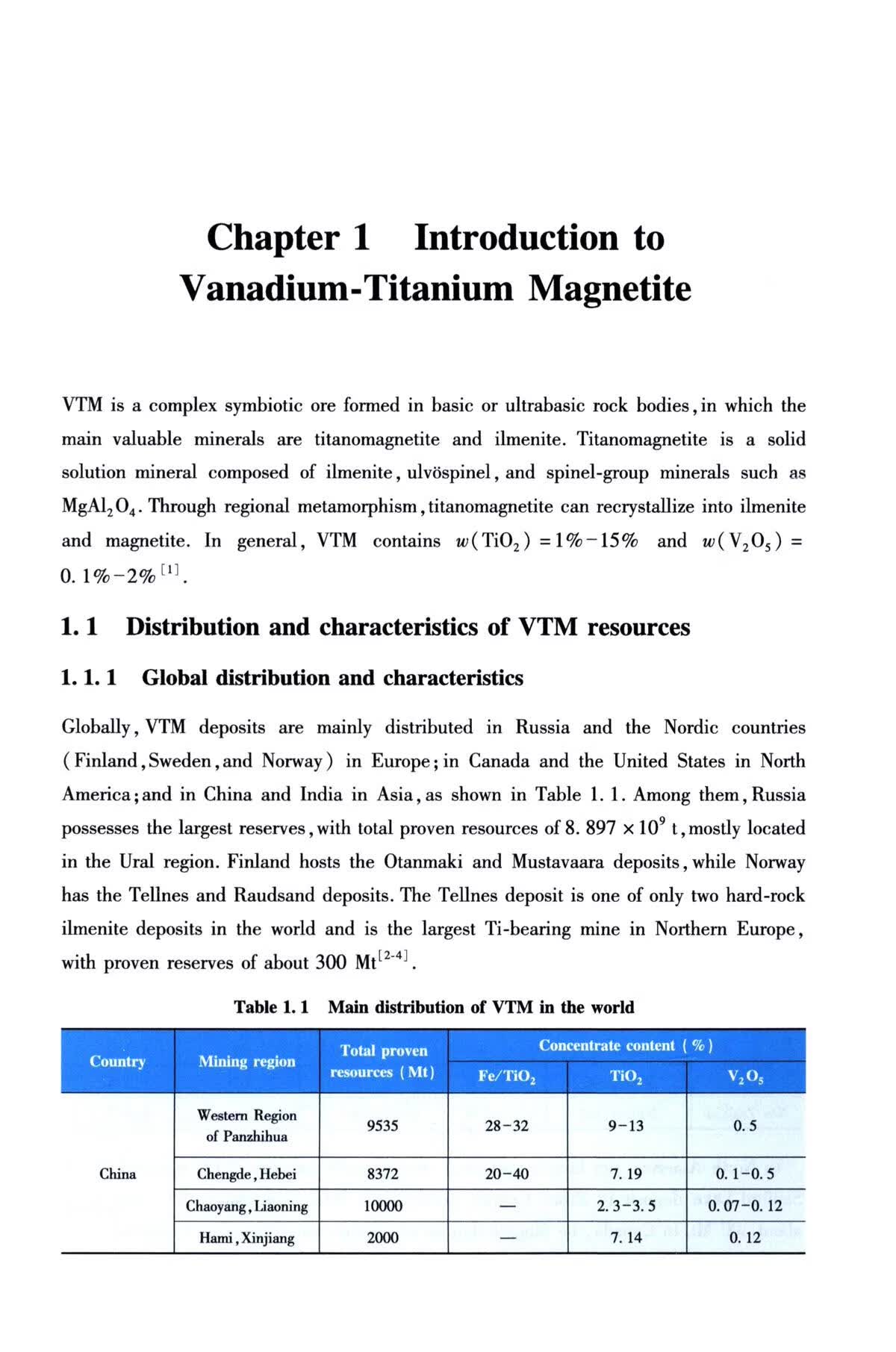
This monograph presents a comprehensive summary of the author’s research on the agglomeration behavior and enhancement of VTM utilization, encompassing ten chapters. Chapter 1 introduces the geological characteristics,distribution, and utilization technologies of VTM, underscoring its abundance, strategic importance, and the urgent need for technological innovation to enable efficient and sustainable exploitation of this complex mineral resource. Chapter 2 reviews agglomeration techniques for VTM and outlines the metallurgical performance indices of the resulting agglomerated products, while Chapter 3 proposes effective approaches to improve both sinter and pellet performance through boron addition, which stabilizes mineral phases, promotes liquid phase formation, enhances bonding, improves reducibility, and reduces fuel consumption. Chapters 4 and 5 further investigate the effects of B203 addition on sinter and pellet properties, respectively, detailing its role in regulating microstructure and improving metallurgical performance. Chapter 6 focuses on the application of oxygen-enriched sintering technology for VTM, analyzing continuous and stage-specific oxygen enrichment strategies using pot tests, thermal imaging, and microstructural analysis to elucidate phase evolution, sintering dynamics, and desulfurization mechanisms. Chapter 7 explores the influence of finely ground limestone and dolomite on VTM sinter basicity and mechanical properties, clarifying their mechanisms of improvement. Chapter 8 examines the impact of return fines, specifically particle size, mass ratio, and embedding position, on sintering productivity and bed permeability, offering practical optimization strategies for industrial operations. Chapter 9 assesses the substitution of Indonesian sea sand for VTM concentrate, presenting systematic studies on sintering performance and metallurgical outcomes at varying substitution levels. Finally, Chapter 10 highlights key scientific and technological breakthroughs achieved in the industrial application of VTM, concluding with general remarks and perspectives for future research and development.
Table of Contents
Chapter 1 Introduction to Vanadium-Titanium Magnetite 1
1.1 Distribution and characteristics of VTM resources 1
1.1.1 Global distribution and characteristics 1
1.1.2 Distribution and characteristics in China 3
1.2 Comprehensive utilization routes for vanadium-titanium magnetite resources 4
1.2.1 Blast furnace—converter route 5
1.2.2 Pre-reduction—electric furnace process 6
1.2.3 Reduction—grinding—separation route 7
1.2.4 Shaft furnace—electric furnace route 8
1.2.5 Rotary kiln—electric furnace process 8
1.2.6 Rotary hearth furnace—electric furnace process 9
1.3 Summary 10
References 10
Chapter 2 Agglomeration for Vanadium-Titanium Magnetite and Metallurgical Performance of Agglomerated Products 13
2.1 Agglomeration target 13
2.2 Agglomeration methods 13
2.2.1 Sintering 13
2.2.2 Pelleting 15
2.3 Metallurgical performance of agglomerated products and characterization methods 15
2.3.1 VTM sinter 15
2.3.2 VTM pellets 18
2.4 Summary 19
References 19
Chapter 3 Measures to Improve the Metallurgical Performance of Vanadium-Titanium Magnetite Agglomerated Products 24
3.1 Measures for vanadium-titanium magnetite sinter 24
3.1.1 Granulation optimization 24
3.1.2 Ore blend optimization 25
3.1.3 Additives: boron containing materials 26
3.2 Measures for vanadium-titanium magnetite pellets 26
3.2.1 Grinding pre-treatment 26
3.2.2 Ore blend optimization 27
3.2.3 Additives; solid fuels, fluxes, and boron-containing compounds 28
3.3 Application of boron-containing materials in VTM furnace feed 28
3.3.1 Application of boron-containing materials in sinter 29
3.3.2 Application of boron-containing materials in pellets 32
3.4 Summary 34
References 35
Chapter 4 Mechanism of B2 03 in Regulating the Microstructure of Vanadium-Titanium Magnetite Sinter 39
4.1 Background 39
4.2 Experimental work 40
4.2.1 Raw materials 40
4.2.2 Methods 41
4.3 The effect of B2O3 addition on the sintering of vanadium-titanium magnetite concentrates 42
4.3.1 Performance indicators of H-VTM sinter 42
4.3.2 Metallurgical properties of H-VTM sinter 45
4.3.3 Microstructure of H-VTM sinter 48
4.4 Summary 51
References 51
Chapter 5 Mechanism of B2 03 in Regulating the Microstructure of Vanadium-Titanium Magnetite Pellets 53
5.1 Background 53
5.2 Experimental work 54
5.2.1 Raw materials 54
5.2.2 Experimental process of pellets 54
5.2.3 Pores area ratio and fracture toughness 55
5.3 Changes in the strength of VTM pellets with different B2O3 additions 57
5.4 Changes in microstructure of VTM pellets with different B2O3 additions 60
5.5 Summary 65
References 65
Chapter 6 Oxygen-enriched Sintering Technology for Vanadium-Titanium Magnetite 67
Chapter 7 Function of Finely Ground Limestone and Dolomite on the Regulation of Vanadium-Titanium Magnetite Sinter Basicity 99
Chapter 8 The Effect of Embedding Returned Fines on the Sintering Process of High-Proportion Vanadium-Titanium Magnetite Concentrates 111
Chapter 9 Effect of Indonesian Sea Sand on Sinter’s Quality when Replacing Vanadium-Titanium Magnetite Concentrate 126
Chapter 10 Industrial-Scale Applications and Future Perspectives 137
Sample Pages Preview
Agglomeration Processes for Vanadium-Titanium Magnetite:Mechanistic Insights,Synergistic Optimization and Industrial-Scale Applications