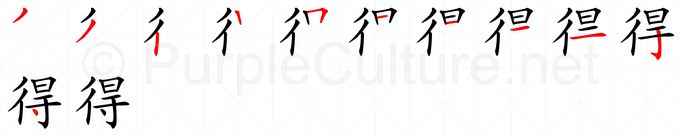
| 得到HSK 4 | dé dào | to get; to obtain; to receive | |
| 获得HSK 4 | huò dé | to obtain; to receive; to get | |
| 不得HSK 4 | bù dé | must not; may not; not to be allowed; cannot | |
| 取得HSK 4 | qǔ dé | to acquire; to get; to obtain | |
| 得了 | dé le | all right!; that's enough! |
| 觉得HSK 2 | jué de | to think; to feel | |
| 显得HSK 5 | xiǎn de | to seem; to look; to appear | |
| 记得HSK 3 | jì de | to remember | |
| 使得HSK 4 | shǐ de | usable; workable; feasible; doable; to make; to cause | |
| 懂得HSK 4 | dǒng de | to understand; to know; to comprehend |
| 总得 | zǒng děi | must; have to; be bound to | |
| 非得 | fēi děi | (followed by a verb phrase, then – optionally – 不可 , or 不行 etc) must | |
| 必得 | bì děi | must; have to | |
| 得亏 | děi kuī | luckily; fortunately | |
| 得尔塔 | děi ěr tǎ | delta (Greek letter Δδ) |
| 1 | Ah! You did really well on the exam! | |
| 2 | I feel very cold. | |
| 3 | The north wind blows very cold. | |
| 4 | I have to get up early tomorrow. | |
| 5 | He seems dull-witted. |
Copyright © Purple Culture Co., Ltd. 2001 - 2026. All right reserved.