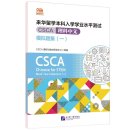
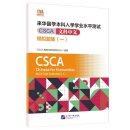
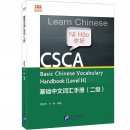
CSCA Easy Pass: Basic Chinese Vocabulary Handbook is the first set of vocabulary handbooks aligned with the CSCA examination syllabus. Compiled strictly in accordance with the CSCA vocabulary syllabus, it fully matches the exam requirements, enabling learners to study targeted vocabulary and take the exam with confidence.
This book is the first volume in the series, featuring 2,093 words carefully selected in line with the CSCA examination vocabulary syllabus. It helps learners quickly build a basic vocabulary framework, master the standard usage of common words, and develop the habit of expressing themselves correctly. The book is designed to help students lay a solid foundation in vocabulary and pave the way for further language development and specialized study.
About the Author
Yin Siqin (Co-editor) is a faculty member at the School of International Education, China University of Geosciences (Wuhan). With over a decade of experience in Teaching Chinese as an International Language, she is responsible for the university’s preparatory education program for international students. She previously served as a volunteer Chinese language teacher at the Confucius Institute at the University of Veliko Tarnovo, Bulgaria. She has served as lead editor and contributing editor for several textbooks and academic monographs. She has directed a key project in teaching resource development funded by the Center for Language Education and Cooperation (CLEC) of the Ministry of Education. Her course designs have received multiple awards. Over the years, she has guided more than thirty international students to win awards in various competitions at all levels and has been honored with the title of Outstanding Instructor on numerous occasions.
Xu Feng(Co-editor) Ph.D., Professor, Deputy Director of the Foreign Student Education Management Branch of the Chinese Association of Higher Education, Secretary-General of the Professional Committee for the Management of Foreign Students of the Hubei Education International Exchange Association, Member of the Guidance Committee for Preparatory Education for Chinese Government Scholarship Undergraduate Students in China under the Ministry of Education, and Expert of the Higher Education Quality Accreditation Project Committee for Foreign Students in China.
Editorial Review
1. Stay tightly aligned with the syllabus, with every word chosen with precision. All the words in this book are strictly selected according to the CSCA Exam Vocabulary Syllabus, ensuring full coverage of the basic and high-frequency words required at Level 1 and giving students an authoritative, reliable foundation to learn from.
2. Clear definitions that make understanding easier. Each entry provides an accurate Chinese definition, pinyin, part of speech, and a concise English equivalent, lowering the barrier to comprehension and making the book especially suitable for beginner and intermediate Chinese learners.
3. Typical example sentences that stay close to real life. Every entry comes with example sentences set in contexts close to campus life and everyday communication, helping students understand how words are used in real situations and make the leap from “recognizing and memorizing” to “using”.
4. Step by step, building a systematic framework. The words are arranged with both frequency and difficulty in mind, helping students build their own vocabulary system gradually, from easier to harder, and keeping frustration out of the learning process.
5. A closed-loop design for efficient learning. The book keeps the vocabulary used in definitions and example sentences strictly within bounds, making sure nothing goes beyond the syllabus and creating a self-contained learning loop that helps students focus on the core and learn more efficiently.
Suggestion
1.Combine systematic learning with daily accumulation. Students are advised to make a plan, study a set amount each day, and understand how words are used through example sentences. They can also do listening and reading exercises to reinforce memory.
2.Balance active output with repeated review. Pay attention to word collocation examples and try making sentences with the given collocations. After learning, make plenty of sentences or short dialogues using new words, review regularly, and keep your own vocabulary notebook.
3. Learn vocabulary together with developing a sense of context. Focus on how words are used in example sentences and their pragmatic functions and gradually cultivate a feel for Chinese.