Details
As an authoritative work examining China's economic trajectory, the book Open China, Global Prosperity features a selection of commentaries originally published in China Daily. Its distinguished lineup of contributors includes many experts and leaders such as Gim Huay Neo, managing director of the World Economic Forum, Harley Seyedin, president of the American Chamber of Commerce in South China, and Csaba Kandrács, deputy governor of the Central Bank of Hungary. The articles compiled in the book outline the underlying logic of China's development, provide deep insights into the remarkable achievements of Chinese modernization, and offer expert perspectives on the future direction of the Chinese economy. The authors highlight the catalytic role of China's ongoing industrial transformation and upgrading in fueling a new momentum for global economic development. The experts analyze the opportunities emerging from the Chinese market from various perspectives, underscoring how China's open-door policy and its win-win development model positively impact global economic growth.
About the Author
Since its launch in 1981, China Daily has grown to become the nation’s leading English-language newspaper. With a combined print, online and mobile readership of more than 350 million, it serves a vital role in telling the world about China, providing valuable insight into the world’s second-largest economy. Consequently, it is quoted more often by overseas media than any other Chinese publication.
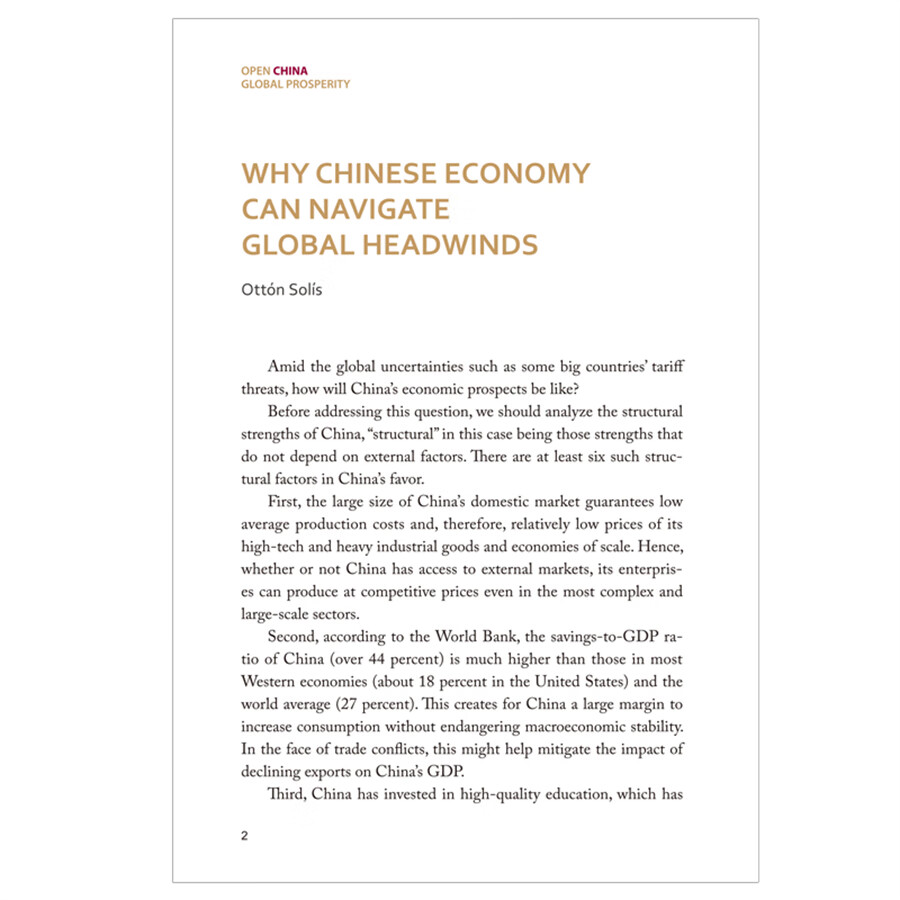
Amid the global uncertainties such as some big countries’ tariff threats, how will China’s economic prospects be like?
Before addressing this question, we should analyze the structural strengths of China, “structural” in this case being those strengths that do not depend on external factors. There are at least six such structural factors in China’s favor.
First, the large size of China’s domestic market guarantees low average production costs and, therefore, relatively low prices of its high-tech and heavy industrial goods and economies of scale. Hence, whether or not China has access to external markets, its enterprises can produce at competitive prices even in the most complex and large-scale sectors.
Second, according to the World Bank, the savings-to-GDP ratio of China (over 44 percent) is much higher than those in most Western economies (about 18 percent in the United States) and the world average (27 percent). This creates for China a large margin to increase consumption without endangering macroeconomic stability. In the face of trade conflicts, this might help mitigate the impact of declining exports on China’s GDP.
Third, China has invested in high-quality education, which has helped create a very productive and adaptable labor force. An educated population can better comprehend budget constraints, the value of forfeiting short-term aspirations for long-term national strategic objectives, and the broad set of contesting factors that ought to be contemplated when drawing development policies, all of which feed into high levels of social cohesion, a critical factor in determining the investment ratio and GDP growth.
Fourth, since ancient times China has cultivated an appetite for knowledge and technological solutions to production problems. China invented gunpowder, mechanical clocks, the compass, printing and paper, among other things. After the launch of reform and opening-up in 1978, substantive budget allocations for research and development have strengthened the quest for science, enabling the country to compete with the West in several cutting-edge fields.
Fifth, in terms of sustaining economic growth, China’s political system has strengths that are not found in Western economies. The Chinese leadership is pragmatic when choosing and implementing economic policies. For instance, “what matters is that the cat catches mice, no matter black or white”. Therefore, the leadership can and is willing to pick from a whole array of fiscal and monetary tools and use them to achieve its goals. Besides, China’s political system warrants not only social stability but also the continuity of the objectives, strategies and policies, all of which encourage private capital to invest and take risks in long-term ventures.
Finally, starting in 1840 through 1945, China endured attacks and invasions by Western powers and some neighbors. These more than 100 years of aggression, known in Chinese narrative as “the century of humiliation”, are very much instilled into the Chinese psyche, affording a need for unity, self-protection and national strength, which call for hard work, sacrifice, entrepreneurship and social cohesion. This not only facilitates the work of the Communist Party of China, which played a key role in bringing to an end that “humiliation”, but has also positively contributed to the competitiveness of the economy.
The West might choose to intensify its animosity toward China, ignited chiefly by economic fears, with tariff wars aimed at halting its progress, thus ignoring that China’s structural-historical factors ensure the country’s progress with its own dynamics and self-sustainability. True, some sources estimate China’s exports-GDP ratio amounts to nearly 18 percent. But if tariffs reduced its exports to 14.4 percent of GDP, though a very unlikely event, domestic consumption can easily offset it by a corresponding reduction in the savings-GDP ratio of 3.6 percentage points, bringing the savings-GDP ratio to about 41 percent, still much higher than the West’s average savings rate. In such a scenario, the impact of tariffs on China’s GDP would be minimal, if any, while consumption and the quality of life in China would improve.
Moreover, some big Western countries’ measures have, unintentionally, become a key factor in strengthening “team China”. Therefore, in addition to the structural positive factors mentioned above, the prospects for the Chinese economy and its overall standing in the world may have been enhanced and improved.
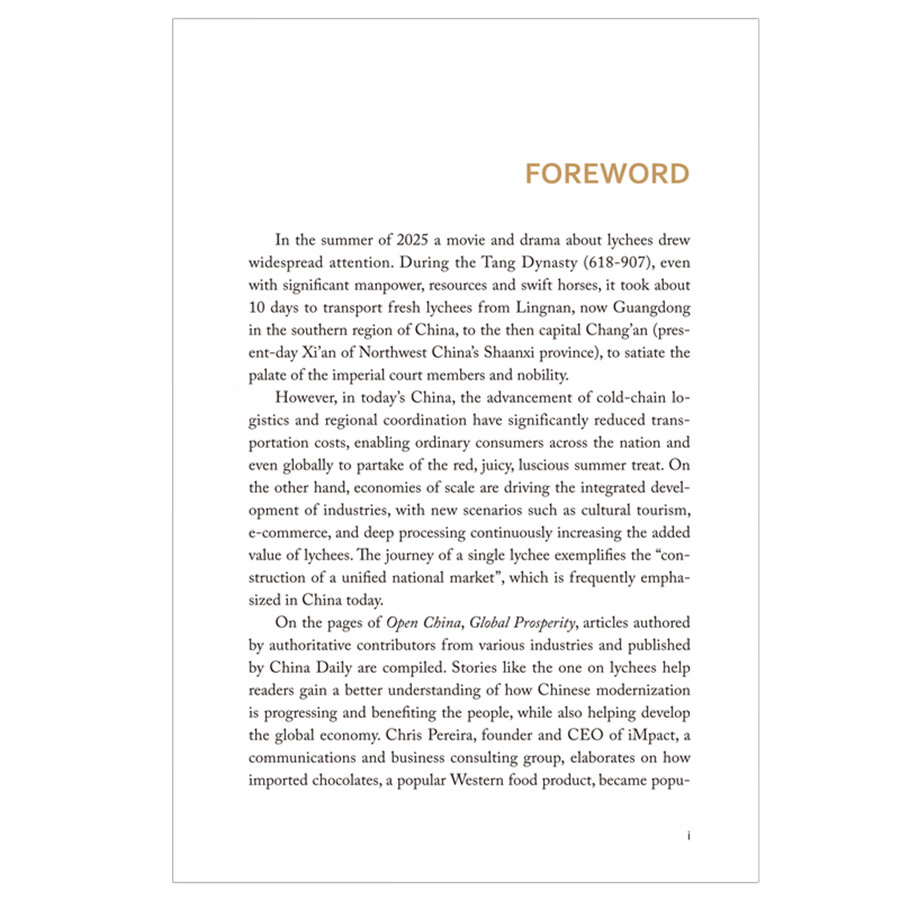
FOREWORD
In the summer of 2025 a movie and drama about lychees drew widespread attention. During the Tang Dynasty (618-907), even with significant manpower, resources and swift horses, it took about 10 days to transport fresh lychees from Lingnan, now Guangdong in the southern region of China, to the then capital Chang’an (present-day Xi’an of Northwest China’s Shaanxi province), to satiate the palate of the imperial court members and nobility.
However, in today’s China, the advancement of cold-chain logistics and regional coordination have significantly reduced transportation costs, enabling ordinary consumers across the nation and even globally to partake of the red, juicy, luscious summer treat. On the other hand, economies of scale are driving the integrated development of industries, with new scenarios such as cultural tourism, e-commerce, and deep processing continuously increasing the added value of lychees. The journey of a single lychee exemplifies the “construction of a unified national market”, which is frequently emphasized in China today.
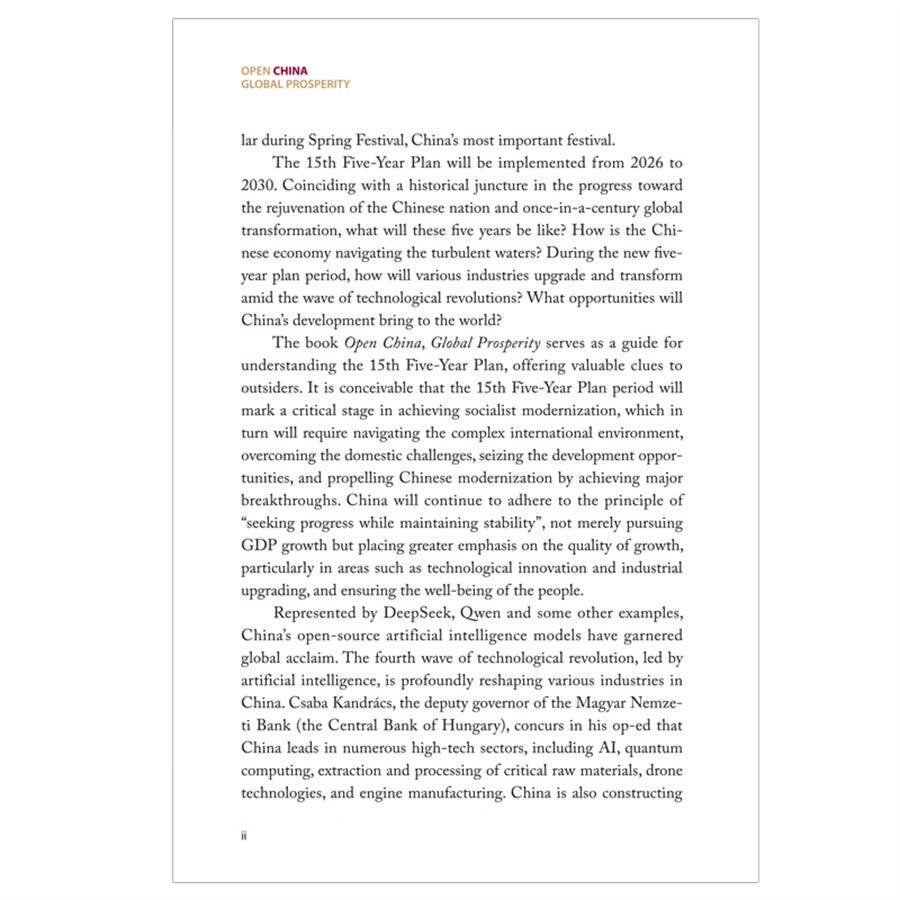
On the pages of Open China, Global Prosperity, articles authored by authoritative contributors from various industries and published by China Daily are compiled. Stories like the one on lychees help readers gain a better understanding of how Chinese modernization is progressing and benefiting the people, while also helping develop the global economy. Chris Pereira, founder and CEO of iMpact, a communications and business consulting group, elaborates on how imported chocolates, a popular Western food product, became popular during Spring Festival, China’s most important festival.
The 15th Five-Year Plan will be implemented from 2026 to 2030. Coinciding with a historical juncture in the progress toward the rejuvenation of the Chinese nation and once-in-a-century global transformation, what will these five years be like? How is the Chinese economy navigating the turbulent waters? During the new fiveyear plan period, how will various industries upgrade and transform amid the wave of technological revolutions? What opportunities will China’s development bring to the world?
The book Open China, Global Prosperity serves as a guide for understanding the 15th Five-Year Plan, offering valuable clues to outsiders. It is conceivable that the 15th Five-Year Plan period will mark a critical stage in achieving socialist modernization, which in turn will require navigating the complex international environment, overcoming the domestic challenges, seizing the development opportunities, and propelling Chinese modernization by achieving major breakthroughs. China will continue to adhere to the principle of “seeking progress while maintaining stability”, not merely pursuing GDP growth but placing greater emphasis on the quality of growth, particularly in areas such as technological innovation and industrial upgrading, and ensuring the well-being of the people.
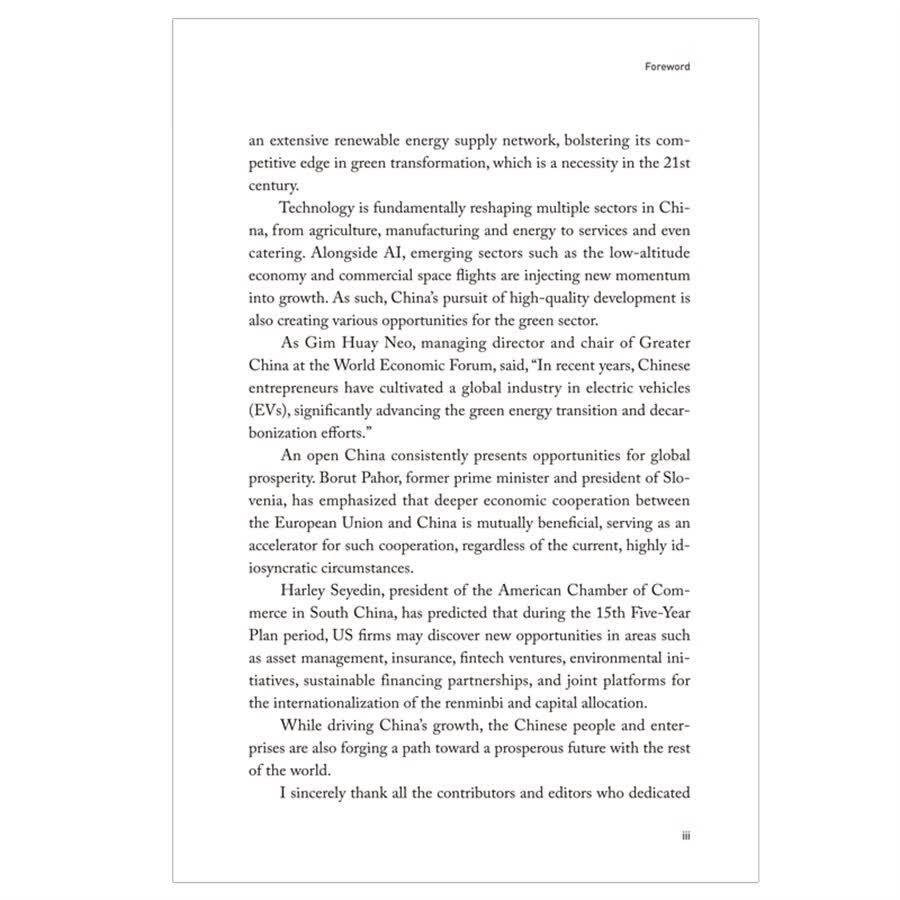
Represented by DeepSeek, Qwen and some other examples, China’s open-source artificial intelligence models have garnered global acclaim. The fourth wave of technological revolution, led by artificial intelligence, is profoundly reshaping various industries in China. Csaba Kandrács, the deputy governor of the Magyar Nemzeti Bank (the Central Bank of Hungary), concurs in his op-ed that China leads in numerous high-tech sectors, including AI, quantum computing, extraction and processing of critical raw materials, drone technologies, and engine manufacturing. China is also constructing an extensive renewable energy supply network, bolstering its competitive edge in green transformation, which is a necessity in the 21st century.
Technology is fundamentally reshaping multiple sectors in China, from agriculture, manufacturing and energy to services and even catering. Alongside AI, emerging sectors such as the low-altitude economy and commercial space flights are injecting new momentum into growth. As such, China’s pursuit of high-quality development is also creating various opportunities for the green sector.
As Gim Huay Neo, managing director and chair of Greater China at the World Economic Forum, said, “In recent years, Chinese entrepreneurs have cultivated a global industry in electric vehicles (EVs), significantly advancing the green energy transition and decarbonization efforts.”
An open China consistently presents opportunities for global prosperity. Borut Pahor, former prime minister and president of Slovenia, has emphasized that deeper economic cooperation between the European Union and China is mutually beneficial, serving as an accelerator for such cooperation, regardless of the current, highly idiosyncratic circumstances.
Harley Seyedin, president of the American Chamber of Commerce in South China, has predicted that during the 15th Five-Year Plan period, US firms may discover new opportunities in areas such as asset management, insurance, fintech ventures, environmental initiatives, sustainable financing partnerships, and joint platforms for the internationalization of the renminbi and capital allocation.
While driving China’s growth, the Chinese people and enterprises are also forging a path toward a prosperous future with the rest of the world.
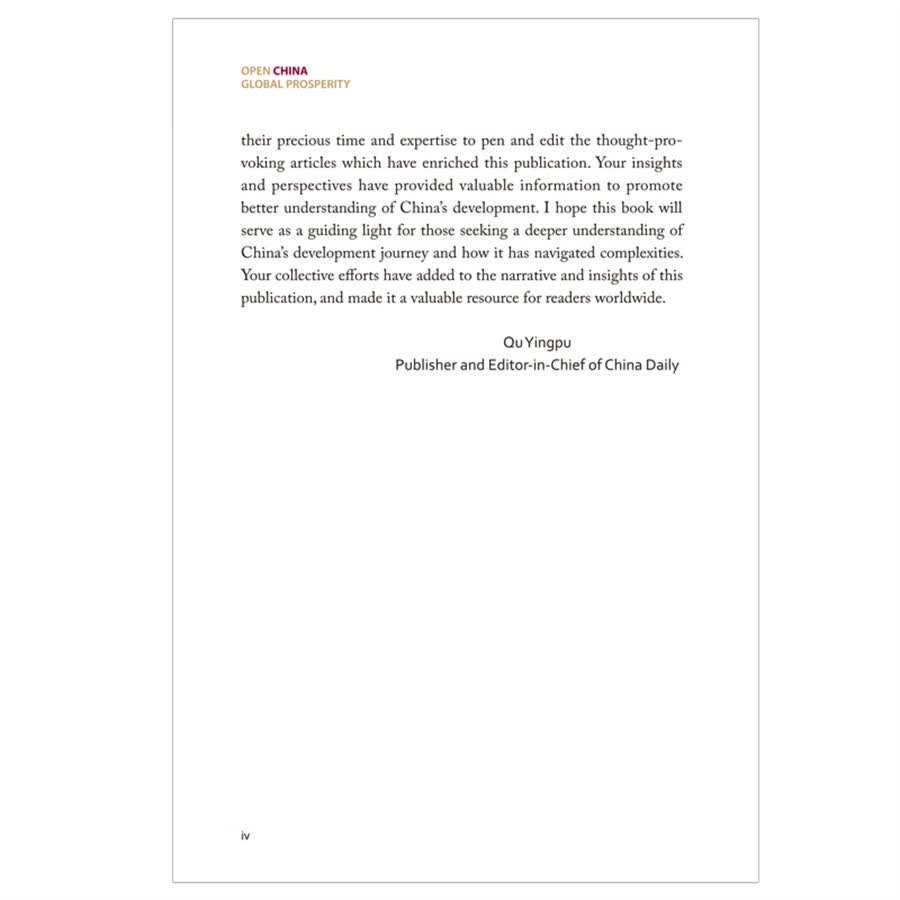
I sincerely thank all the contributors and editors who dedicated their precious time and expertise to pen and edit the thought-provoking articles which have enriched this publication. Your insights and perspectives have provided valuable information to promote better understanding of China’s development. I hope this book will serve as a guiding light for those seeking a deeper understanding of China’s development journey and how it has navigated complexities. Your collective efforts have added to the narrative and insights of this publication, and made it a valuable resource for readers worldwide.
Qu Yingpu
Publisher and Editor-in-Chief of China Daily