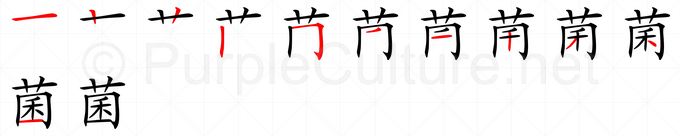
| 细菌HSK 6 | xì jūn | bacterium; germ | |
| 病菌 | bìng jūn | harmful bacteria; pathogenic bacteria; germs | |
| 杀菌 | shā jūn | to kill germs; to disinfect; to sterilize | |
| 杆菌 | gǎn jūn | bacillus (any rod-shaped bacteria) | |
| 真菌 | zhēn jūn | fungi; fungus |
| 伞菌 | sǎn jùn | agaric | |
| 马勃菌 | mǎ bó jùn | puffball (mushroom in the division Basidiomycota) | |
| 松菌 | sōng jùn | matsutake (Tricholoma matsutake), edible mushroom considered a great delicacy in Japan | |
| 食菌 | shí jùn | edible mushroom | |
| 菌伞 | jùn sǎn | mushroom top |
| 1 | Bacteria can survive in harsh environments. | |
| 2 | Most bacteria reproduce through binary fission. | |
| 3 | Bacteria are the most common type of microorganisms. | |
| 4 | Imbalance of intestinal flora can easily cause physical discomfort | |
| 5 | Bacteria can take the form of spheres, rods, or spirals. |
Copyright © Purple Culture Co., Ltd. 2001 - 2026. All right reserved.