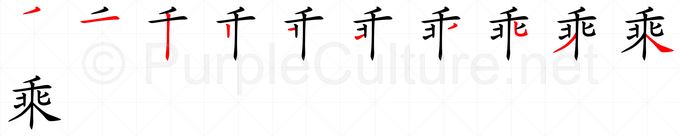
| 乘客 | chéng kè | passenger | |
| 乘坐HSK 4 | chéng zuò | to ride (in a vehicle) | |
| 乘车 | chéng chē | to ride (in a car or carriage); to drive; to motor | |
| 乘机 | chéng jī | to take the opportunity; to take a plane | |
| 乘势 | chéng shì | to seize the opportunity; to strike while the iron is hot |
| 大乘 | dà shèng | Mahayana, the Great Vehicle; Buddhism based on the Mayahana sutras, as spread to Central Asia, China and beyond; also pr. [Da4 cheng2] | |
| 小乘 | xiǎo shèng | Hinayana, the Lesser Vehicle; Buddhism in India before the Mayahana sutras; also pr. [Xiao3 cheng2] |
| 1 | I am going to take a bus to go to the supermarket. | |
| 2 | I take the subway to school every day. | |
| 3 | Please take the escalator up. | |
| 4 | He often takes taxis for transportation. | |
| 5 | I don't know which bus to take. |
Copyright © Purple Culture Co., Ltd. 2001 - 2026. All right reserved.