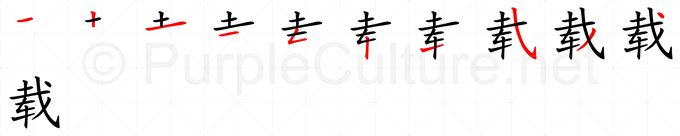
| 载体 | zài tǐ | carrier (chemistry); vector (epidemiology); vehicle or medium | |
| 超载 | chāo zài | to overload | |
| 承载 | chéng zài | to bear the weight; to sustain | |
| 运载火箭 | yùn zài huǒ jiàn | carrier rocket | |
| 满载 | mǎn zài | full to capacity; fully loaded |
| 记载HSK 6 | jì zǎi | to write down; to record; written account | |
| 登载 | dēng zǎi | to publish (in newspapers or magazines); to record (bookkeeping entries) | |
| 连载 | lián zǎi | serialized; published as a serial (in a newspaper) | |
| 刊载 | kān zǎi | to publish | |
| 转载 | zhuǎn zǎi | to forward (a shipment); to reprint sth published elsewhere; Taiwan pr. [zhuan3 zai4] |
| 1 | The bus can carry up to 60 passengers. | |
| 2 | You can download the software for free. | |
| 3 | Folk songs are a carrier for transmitting folk culture. | |
| 4 | This ship is loaded with a large amount of cargo. | |
| 5 | The ship is loaded with a lot of cargo. |
Copyright © Purple Culture Co., Ltd. 2001 - 2026. All right reserved.